 GG Transcript
How to Turn YouTube Transcripts into Notes and Summaries
Break useful information free from the video timeline so it can be searched, reviewed, and reused.
 Harry Vu Le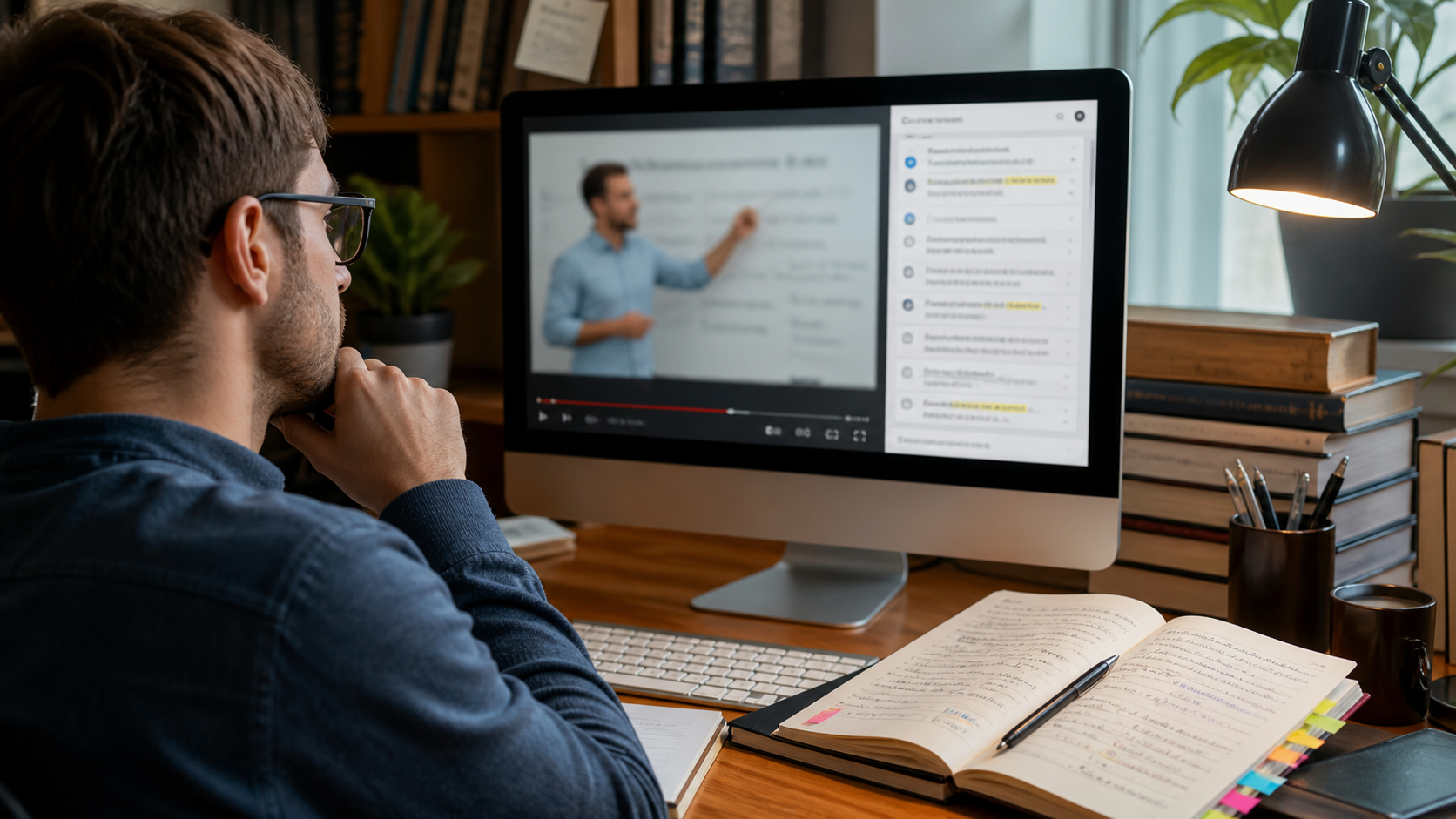
The limitation of linear video
YouTube contains an enormous amount of useful information, but video has one fundamental limitation: it is linear. A person may spend an hour watching a lecture, tutorial, podcast, interview, or conference presentation and later remember exactly what was discussed without remembering where in the video it appeared. Finding that information again often means dragging the timeline back and forth until the right moment eventually appears.
Turning a YouTube video into text solves that problem by changing spoken information into something searchable. A YouTube transcript allows the viewer to scan for keywords, locate important explanations, create notes, and summarize the content without repeatedly replaying the video.
This is particularly valuable for education. Students increasingly learn from long-form video, whether through recorded lectures, tutorials, documentaries, exam explanations, or educational channels. Video can make complicated ideas easier to understand, but it is much less efficient when the student wants to review one specific concept later.
A searchable transcript changes how the video can be used. Instead of remembering that the teacher explained a formula “somewhere near the middle,” the student can search the transcript for the relevant term. The surrounding text provides context immediately, and the student can return to the exact part of the video if necessary.
The same transcript can become the foundation for study notes. Natural speech is rarely organized like a textbook. Speakers repeat themselves, add examples, answer questions, and occasionally wander away from the main subject. A raw transcript captures that detail, while AI can help reorganize it into a more concise learning format.
Search and study from the transcript
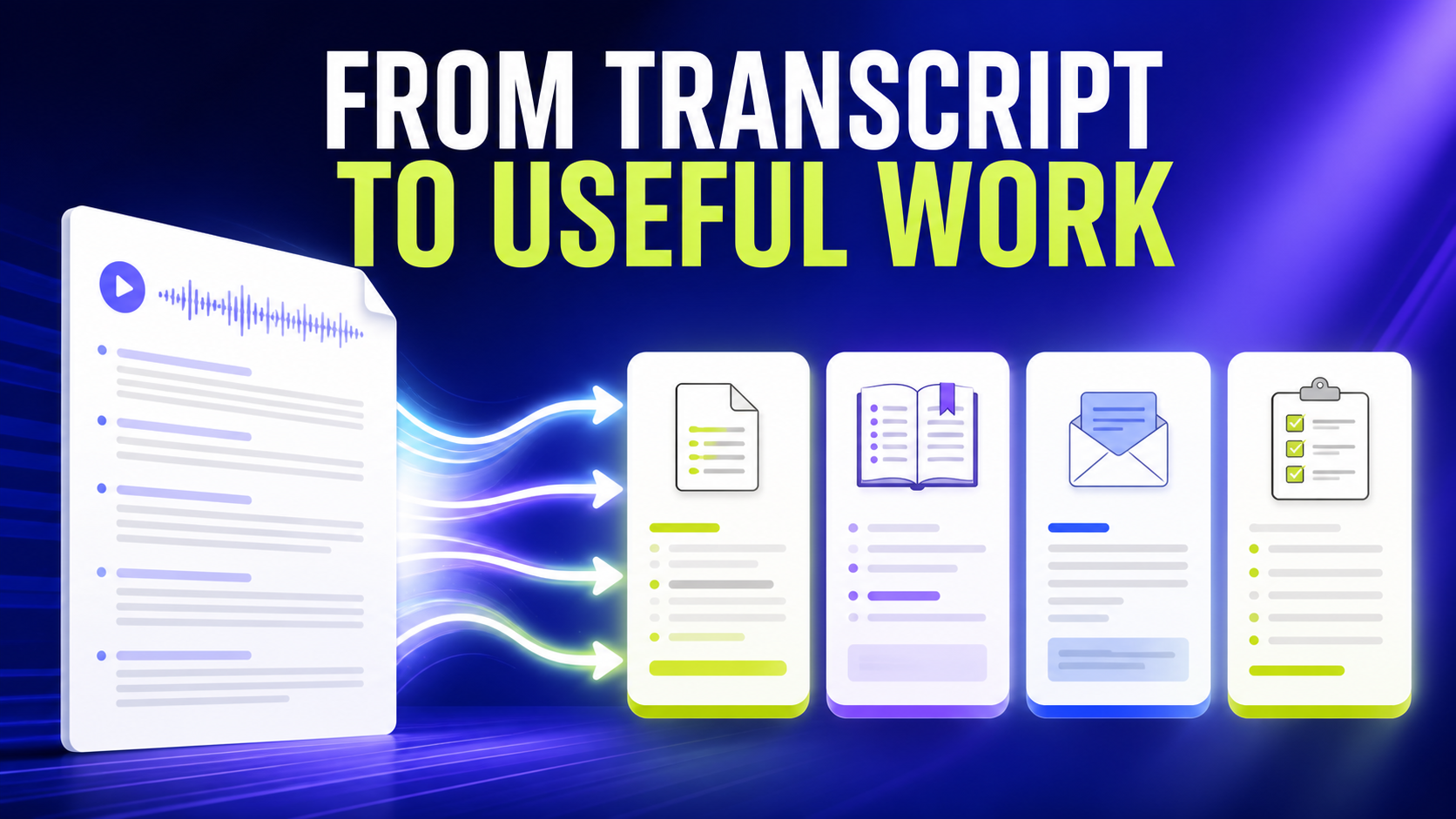
GG Speech is designed around this broader speech-to-text workflow. Transcription creates the text first. From there, the content can become notes, summaries, Q&A, or another structured AI output depending on what the user needs.
Researchers can benefit from searchable video transcription for a similar reason. Increasingly, valuable information appears in podcasts, conference recordings, interviews, and demonstrations rather than traditional written articles. A researcher may need to locate one statement inside a ninety-minute discussion. Doing that through playback alone is inefficient.
Text makes the information much easier to navigate. A keyword can reveal every place a concept appeared. A person's name can identify relevant sections of an interview. Technical terminology can be located without listening to the entire recording again.
Creators can use video transcription in the opposite direction. A YouTube video does not need to remain only a video. The transcript can become source material for an article, newsletter, show notes, social content, summary, educational resource, or description.
Reuse video ideas as written content
This is particularly useful because long-form creators often spend significant time saying things they later need to write again. Transcription allows the spoken version to become the starting point for written content instead of requiring the creator to rebuild the ideas from scratch.
Searchable transcripts also help with accessibility. Some people understand written information more easily than spoken information, while others may have difficulty hearing particular sections. Having the text available gives users another way to engage with the same content.
The productivity benefit comes from breaking the connection between information and the video timeline. Without transcription, the viewer must generally move through the content in the order it was recorded. With a searchable transcript, the video becomes more like a document. The user can jump directly to the section that matters.
That shift is surprisingly powerful. A sixty-minute video no longer always requires sixty minutes of attention the second time it is used. The transcript becomes a map of the information inside it.
GG Speech fits into this workflow by treating speech-to-text as a source for later work. Once the video content exists as text, it can be searched, reviewed, summarized, or reorganized without losing the connection to the original ideas.
Make long-form video easier to navigate
The goal is not to replace video. Video remains better for demonstrations, emotion, visual explanations, and many forms of learning. The transcript solves a different problem: making the information inside the video easier to find and reuse.
For students, researchers, creators, and professionals who consume large amounts of YouTube content, turning video into searchable text can transform the platform from something that is merely watched into something that can be actively worked with.
A video transcript can make long material easier to study, but it does not replace the video itself. Diagrams, demonstrations, editing choices, and context outside the speaker’s words may be essential to the point being made. Good notes therefore include the title, creator, URL, and useful timestamps, particularly when a claim depends on an on-screen visual. Keeping those references close to the transcript makes a conclusion easier to verify and saves time when a reader needs to revisit the exact moment.
The workflow should also respect the creator and the conditions surrounding the source. Use transcription for material you are permitted to process, do not treat a generated summary as a substitute for checking the original, and avoid sharing text in ways that ignore rights or privacy. A careful study note separates direct quotation from personal interpretation, marks uncertainty instead of smoothing it away, and removes temporary exports once the research work is finished. Those habits make the result more useful without pretending that captured text is the whole source.